

Most people who come to me with skincare questions are not doing anything dramatically wrong. They bought decent products. They wash their face before bed. But their routine is a stack of individual steps with no real logic connecting them, so some ingredients cancel each other out, others never absorb properly, and the expensive serum they added three weeks ago is not doing much because it is sitting under the wrong thing. The result is skin that just feels fine, not actually better.
The fix is not adding more products. It is getting the order and the pairings right. In this guide, I am going to walk through the nighttime routine I have settled on after years of testing, built around the CeraVe Skin Renewing Night Cream as the final sealing step. It contains a peptide complex, hyaluronic acid, and ceramides, which makes it a logical anchor for the whole routine. Everything before it is chosen to prepare your skin to absorb it well. Everything I have cut from this routine made the results worse, not better.
Skip the guesswork: this is the night cream I use as the final step in this routine.
The CeraVe Skin Renewing Night Cream has over 56,000 reviews and a peptide complex that supports the skin's overnight repair window. It is affordable, widely available, and plays well with almost every serum under it.
Amazon Check Today's Price on Amazon →Step 1: Double Cleanse or Cleanse Once, Depending on What You Put on Your Skin That Day
If you wore sunscreen, foundation, or any silicone-based primer during the day, start with an oil cleanser or micellar water before your foaming or gel cleanser. Oil breaks down oil-soluble debris that water-based cleansers cannot fully remove. If you only wore a lightweight moisturizer or nothing at all, a single gentle cleanser is enough. I use a gentle foaming cleanser most nights and add a balm cleanser on the nights I wore tinted mineral SPF.
The thing to get right here is not stripping your skin. A cleanser that leaves your face feeling tight or squeaky clean has removed too much. Your face should feel neutral when you pat it dry, neither oily nor pulled. If you routinely feel dry immediately after cleansing, that tightness carries through every step after it and makes your moisturizer work harder than it should.
Temperature matters more than most people realize. Warm water helps loosen sebum and sunscreen. Cold water after rinsing does not close pores (that is a myth), but it does feel refreshing. What matters is finishing with damp skin, not fully dry skin. Your next step, the toner or serum, absorbs better into slightly damp skin.
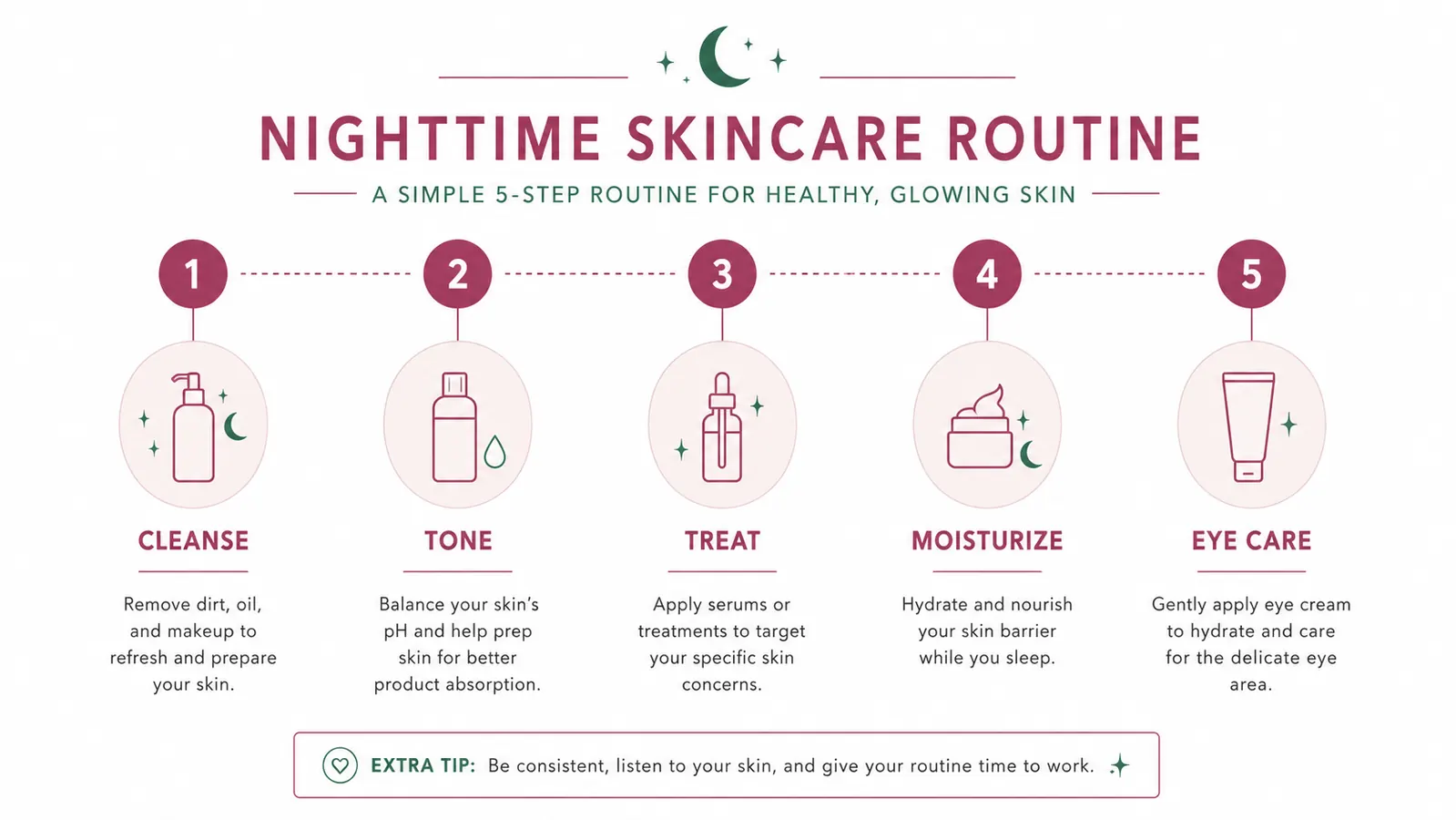
Step 2: Apply a Toner or Essence If Your Skin Is Dry or Textured (Skip It If You Are Acne-Prone)
This step is genuinely optional, and I do not use one every night. But if your skin tends to feel dry or rough by morning, a hydrating toner or essence applied immediately after cleansing can make a noticeable difference. Look for something with panthenol, glycerin, or beta-glucan. Avoid anything with alcohol high in the ingredient list, as that will dehydrate the skin you just cleaned.
If you are acne-prone or using a prescription retinoid, skip toner entirely on those nights. Adding extra hydrating layers under an active can slow absorption and reduce its effectiveness. Some prescription users also find that toners with certain botanical extracts cause mild irritation when layered under tretinoin. Keep this step simple or skip it if your routine already includes an active treatment.
Application method: press it in with clean hands rather than a cotton pad. Cotton pads absorb a significant portion of whatever you put on them. Your skin should feel just barely damp, not wet, when you move to the next step. If you go too wet into the serum step, you dilute the actives and slow absorption.
Step 3: Use a Serum Targeted to Your Specific Concern
This is where most people underestimate how much the choice of serum affects the night cream below it. The CeraVe Skin Renewing Night Cream does its best work when the serums under it are compatible with ceramide-based formulas. That means humectant serums (hyaluronic acid, sodium PCA, glycerin) pair well. Vitamin C works fine at night but should go on dry skin and be fully absorbed before you layer. Niacinamide is a strong pairing. Retinol or tretinoin requires its own protocol (see the note below).
What I use most nights: the CeraVe Hyaluronic Acid Serum with Vitamin B5. It goes on damp skin, absorbs in about sixty seconds, and then I follow with the night cream. That combination has held my skin comfortable through winter in a dry climate without any layering issues. The hyaluronic acid pulls moisture into the skin, and the ceramides in the night cream seal it in. They are doing different jobs, which is why the pairing works and why I keep coming back to it after testing other combinations.
If you use a retinol or prescription retinoid, apply it before the night cream on nights you use it. Some people buffer with a light moisturizer first if they are sensitive, but if your skin has adjusted to retinol you can layer the night cream directly over it once the retinol has dried. Do not use vitamin C and retinol in the same step. They can coexist in a routine when applied on alternating nights, but layering them together in one session raises the irritation risk without meaningful benefit.

Step 4: Apply the CeraVe Skin Renewing Night Cream as Your Final Moisture Layer
This is the step the whole routine is built around. The CeraVe Skin Renewing Night Cream contains a peptide complex, hyaluronic acid, and three ceramides. Peptides are amino acid chains that signal the skin to produce structural proteins. Ceramides are the lipids that make up the outer skin barrier. Used together overnight, they address both the signaling side and the structural side of barrier repair. That is why this formula suits people dealing with dryness, mild texture, or skin that feels thinner or more reactive than it used to.
The texture is a rich but non-greasy cream. I use a half-pea-sized amount for my whole face, maybe slightly more on my cheeks where I tend to dry out. Warm it between your fingertips first and then press it into the skin rather than rubbing. Pressing seals the layers underneath without disrupting the serum you just applied. Wait about ninety seconds before doing anything else, including applying eye cream, to let the film set.
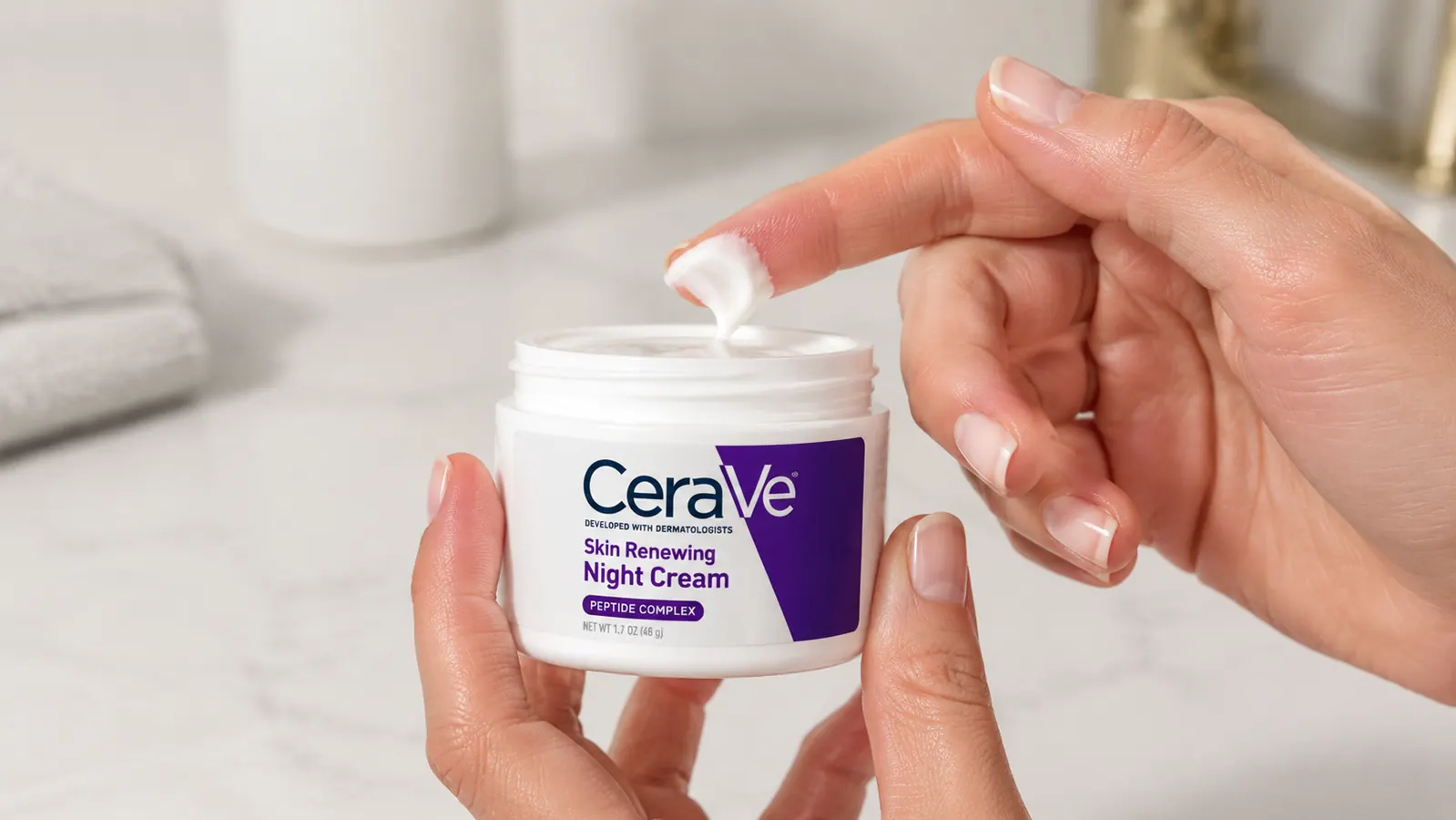
One thing I want to be honest about: this is not a fast-acting product. You are not going to wake up with noticeably different skin after one night. What you will notice after two to four weeks of consistent use is that your skin stays comfortable through the night, that it does not feel as dehydrated when you wake up, and that your morning cleanser step feels more like maintenance than damage repair. Steady improvement over weeks is the sign a ceramide-based formula is working. If after six weeks your skin still feels tight and flaky in the morning, the formula may not be rich enough for your skin type and you would benefit from something with a heavier occlusive base.
Step 5: Finish With Eye Cream If That Is a Concern You Are Targeting
Eye cream is the step most people either skip entirely or add too many of. My position: if you have a specific concern around the orbital area, a dedicated eye cream applied after your moisturizer is worth it. If you do not have a specific concern, your night cream can extend lightly to the orbital bone (not the lid) and cover that area adequately. The ceramide content in the CeraVe formula is gentle enough for the area around the eyes, though I still stop just at the orbital rim and let it migrate slightly from body heat.
Application for eye cream goes on after the night cream because the orbital skin is thinner and more reactive. You want the heavier ceramide layer already in place before anything else touches that area. Use your ring finger, which naturally applies less pressure than your index finger, and tap rather than rub. The tapping motion distributes the product without stretching the skin.
If you are adding a prescription retinoid to your overall routine, keep it away from the eye area unless your dermatologist has specifically guided you to apply it there. The strength levels appropriate for the rest of your face are too high for undereye skin in most cases. That area can benefit from a dedicated retinol eye cream formulated at a lower concentration if you want to address fine lines around the eyes over time.
What Else Helps
Two things outside of product choices make a bigger difference than most people expect. The first is consistency: using this five-step routine seven nights in a row will not produce the same results as using it three or four times a week for two months. Skin barrier repair is cumulative. Ceramide-based formulas in particular work by gradually replenishing the lipid barrier over time, not by providing an immediate hit of hydration. Give the routine at least six weeks before you judge it. The second is sleep position. Sleeping face-down presses your skin against a pillowcase for seven or eight hours, which counteracts what your skincare is trying to do. A clean silk or satin pillowcase reduces friction significantly. It genuinely reduces the compression creasing that shows up as texture over time, and it is inexpensive relative to what most people spend on serums.
People often ask whether water intake or diet affects how well a night cream works. Honest answer: yes, but not in a way that replaces topical care. Drinking water keeps skin comfortable but does not hydrate the outer layers the way a humectant serum does. Eating enough healthy fats (especially omega-3s) supports the lipid content of your skin barrier from the inside, which complements what ceramide topicals are doing from the outside. You do not need to overhaul your diet for this routine to work, but if your skin feels perpetually depleted despite a consistent topical routine, it is worth looking at whether your diet and sleep are pulling in the same direction.
Skin barrier repair is cumulative. A ceramide night cream works by gradually replenishing the lipid barrier over time, not by producing one visible overnight result. Give any new routine at least six weeks before you decide whether it is working.
The CeraVe Night Cream is the last step in this routine for a reason: peptides, hyaluronic acid, and ceramides seal everything else in while you sleep.
Over 56,000 reviews, a derm-developed formula, and it works for dry, combination, and sensitive skin. Check the current price before you add anything else to your cart.
Amazon Check Today's Price on Amazon →